

 English
 Español
 عربى
عربى русский
 中文简体
中文简体
1. What is a Welded Tube Mill? — From Definition to Industry Positioning
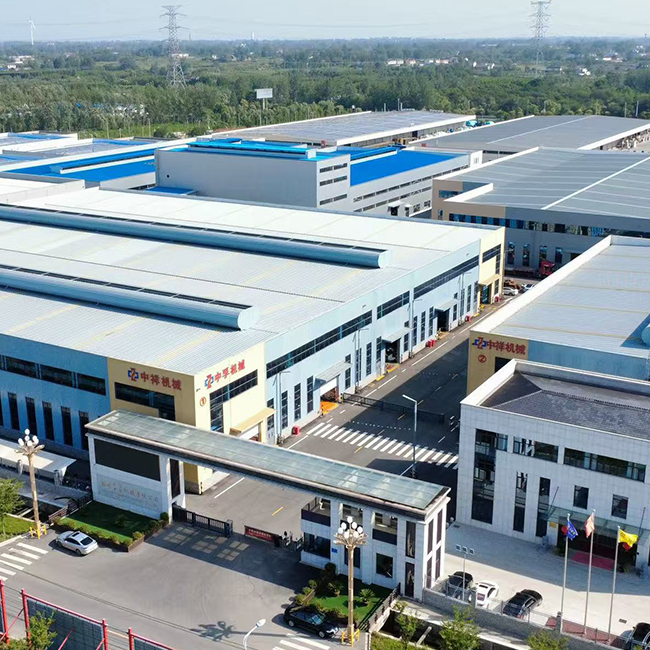
A Welded Tube Mill is a complete set of equipment cluster that processes metal plates or strips into tubular products through welding processes. It covers the entire process from raw material pretreatment to finished product output and serves as the core equipment for welded pipe production. Unlike single pipe-making equipment, a welded tube mill emphasizes "multi-process collaboration" and can be categorized into ERW (Electric Resistance Welding), LFW (Laser Fusion Welding), SAW (Submerged Arc Welding) and other types based on differences in welding technologies. These types respectively meet the needs for small-to-medium caliber precision pipes, high-end stainless steel pipes, large-caliber thick-walled pipes, etc., and are widely used in construction, energy, transportation, machinery and other fields. As a professional manufacturer in the industry, Yangzhou SINOFORM Machinery Co., Ltd. offers a product line of welded tube mills covering two mainstream types: ERW and laser welding, which can meet the diversified production needs from civil pipes to industrial pipes.
2. Technological Evolution of Welded Tube Mills: Iteration from Traditional to Intelligent
2.1 Welding Technology: From "Large Heat-Affected Zone" to "High Precision"
Early welded tube mills mainly adopted high-frequency electric resistance welding (ERW). Although they could achieve efficient production, the heat-affected zone was relatively large (usually >1mm), which easily caused fluctuations in the mechanical properties of pipes. With technological upgrades, laser fusion welding (LFW) mills have gradually become the mainstream in high-end fields — the laser welding tube mills of Yangzhou SINOFORM Machinery Co., Ltd. use 6-10kW fiber lasers, which can control the heat-affected zone within 0.1-0.2mm. The weld strength reaches over 95% of the base material, and no subsequent grinding is required, making them suitable for scenarios with strict requirements on pipe surface quality such as medical devices and food machinery. In addition, to meet the demand for large-caliber thick-walled pipes, submerged arc welding (SAW) mills can achieve stable production of pipes with a wall thickness of 20-80mm through double-wire submerged arc welding technology. At present, such customized mills of SINOFORM Machinery have been applied in chemical pipeline projects.
2.2 Control Technology: From "Manual Adjustment" to "Intelligent Closed-Loop"Traditional welded tube mills relied on manual adjustment of parameters such as forming roll pressure and welding current, resulting in large fluctuations in product precision (e.g., outer diameter tolerance of ±0.5mm). Nowadays, mainstream mills have adopted PLC + touch screen control systems. On this basis, Yangzhou SINOFORM Machinery Co., Ltd. has added "intelligent closed-loop control" — real-time collection of pipe outer diameter data through a laser diameter gauge, automatic feedback and adjustment of forming roll parameters, which controls the outer diameter tolerance within ±0.1mm; the welding link is equipped with an infrared thermometer to monitor the weld temperature in real time and dynamically adjust the output of the high-frequency power supply, avoiding defects such as over-burning or incomplete fusion. The equipment qualification rate has been increased to over 98%.
2.3 Automation Level: From "Segmented Operation" to "Continuous Unmanned Operation"
Early mills required manual completion of links such as steel coil replacement, pipe cutting, and finished product handling, with 6-8 operators needed for a single production line. Now, the welded tube mills of Yangzhou SINOFORM Machinery Co., Ltd. have realized "full-process automation": the double-station uncoiler can automatically switch steel coils, with a coil change time of ≤3 minutes; the CNC flying saw automatically cuts according to the preset length, with a cutting precision of ±0.5mm; the end is equipped with a robotic arm and an automatic baler to realize integrated operations of pipe sorting, stacking and packaging. Only 2-3 personnel are required to monitor a single production line, and the production efficiency is increased by 40%.
3. Core Classification and Scenario Adaptation of Welded Tube Mills
Different types of welded tube mills correspond to different application scenarios due to differences in technical characteristics. Enterprises need to select suitable equipment according to their product positioning:
3.1 ERW Welded Tube Mill: The "Cost-Effective Choice" for Small-to-Medium Caliber Pipes
Technical Features: Adopts high-frequency induction welding, with fast production speed (30-80m/min) and low equipment investment cost, suitable for conventional materials such as low-carbon steel and low-alloy steel.
Typical Scenarios: Construction scaffolding pipes (φ48mm), municipal water supply and drainage pipes (DN50-DN200), automotive structural pipes (φ20-φ50mm).
SINOFORM Advantages: Its ERW mills are equipped with an intelligent tension control system to avoid tensile deformation of steel strips; combined with an eddy current flaw detector, 100% inspection of weld surface defects is realized. The mills have served many domestic building materials enterprises, with a daily output capacity of up to 300 tons.
3.2 Laser Welded Tube Mill: The "Precision Leader" in High-End Fields
Technical Features: Laser welding has a small heat-affected zone and smooth welds, and can process difficult-to-weld materials such as stainless steel and aluminum alloy, suitable for small-caliber precision pipes (φ6-φ50mm).
Typical Scenarios: Pipes for medical devices (e.g., infusion tubes), food-grade delivery pipes, automotive hydraulic oil pipes.
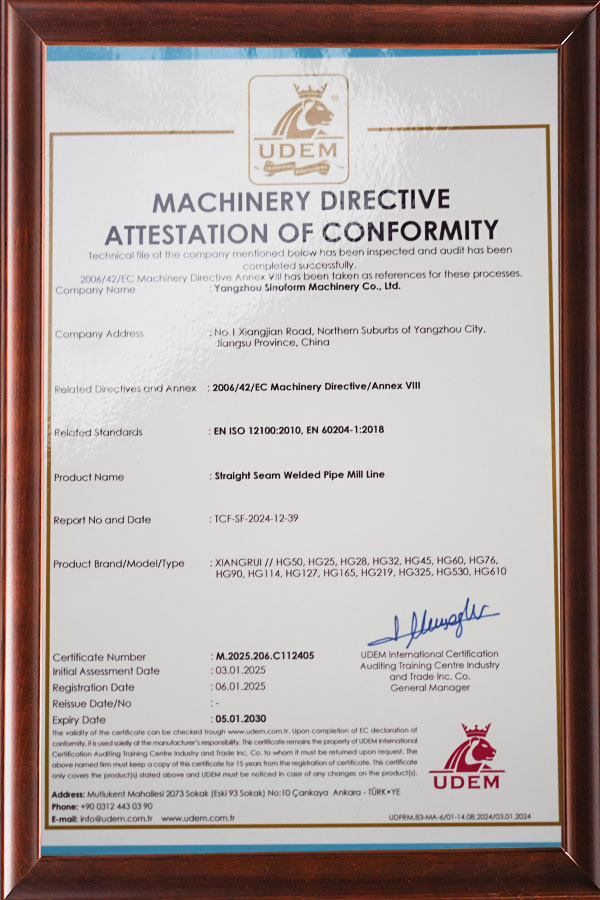
SINOFORM Advantages: The laser welding tube mills have passed the EU CE certification, adopt imported fiber lasers with high stability; equipped with an inner weld protective gas system to avoid oxidation during stainless steel welding, and have been exported to markets such as Greece and Russia.
3.3 Submerged Arc Welded Tube Mill: The "Industrial Necessity" for Large-Caliber Thick-Walled Pipes
Technical Features: Adopts submerged arc welding, with large weld penetration depth, and can process thick-walled pipes with a wall thickness of 20-80mm and a caliber of φ219-φ2000mm, suitable for high-strength steel and alloy steel pipes.
Typical Scenarios: Low-pressure oil and gas transmission pipes, chemical pipelines, steel structure pillar pipes.
SINOFORM Advantages: The customized submerged arc welded tube mills can adjust the number of welding layers (2-4 layers) according to the pipe wall thickness, and are equipped with an X-ray flaw detector to inspect internal defects. They have been applied in domestic natural gas branch pipeline projects.
4. Key Selection Factors for Welded Tube Mills: 4 Core Considerations
When purchasing a welded tube mill, enterprises should avoid "blindly pursuing high-end products" or "only focusing on price", and conduct a comprehensive evaluation based on the following 4 points:
4.1 Product Positioning: Clarify "What Type of Pipe to Produce"
If producing civil construction pipes, an ERW mill is sufficient to meet the needs; if producing stainless steel medical pipes, a laser welding mill is required; if producing large-caliber industrial pipes, a submerged arc welding mill is needed. For example, an automotive parts enterprise needed to produce φ30mm stainless steel hydraulic pipes, and Yangzhou SINOFORM Machinery Co., Ltd. recommended a laser welding mill for it, combined with a degreasing cleaner and a laser diameter gauge to ensure pipe precision and surface quality.
4.2 Production Capacity Requirement: Match the "Production Scale"
For small-batch and multi-specification production (daily output <50 tons), a modular mill can be selected for easy model change; for large-batch and single-specification production (daily output >200 tons), a high-speed continuous mill is required. For instance, the ERW high-speed line of SINOFORM Machinery can realize 24-hour continuous operation, with a mean time between failures (MTBF) of ≥3000 hours.
4.3 Material Adaptability: Focus on "Equipment Compatibility"
For processing low-carbon steel, a conventional ERW mill can be selected; for processing stainless steel, a laser welding or ERW mill with inert gas protection is required; for processing aluminum alloy, a forming roll and welding system with special design are needed. SINOFORM Machinery can customize roll profiles and welding parameters according to material characteristics.
4.4 Cost Budget: Balance "Upfront Investment and Post-Operation Maintenance"
The upfront investment of laser welding mills is relatively high (about 2-3 times that of ERW mills), but no subsequent grinding process is needed, and the consumable cost is low; the upfront investment of ERW mills is low, but parts such as high-frequency induction coils need to be replaced regularly. Yangzhou SINOFORM Machinery Co., Ltd. provides "equipment + operation and maintenance" packages to reduce the post-maintenance cost of enterprises, such as free 1-year spare parts replacement service.